
Another Slice of Dutch Internet History
There has been a long list of failed internet technologies over the past few decades. Much like the current AI rush, the early internet was a bit of a Wild West. People had many ideas and tried almost anything to see what would stick.
One of those failed technologies was WebTV. For a short time, it looked as though this piece of technology might also find its way into Dutch homes. Except it didn’t.
This is the story of how WebTV was killed before it even launched in the Netherlands, including what I consider a betrayal by one of the business partners.
It is told from my personal involvement and based on my own recollection of events – your mileage may vary.
Listen to this story as a Podcast!
A Bit of Background
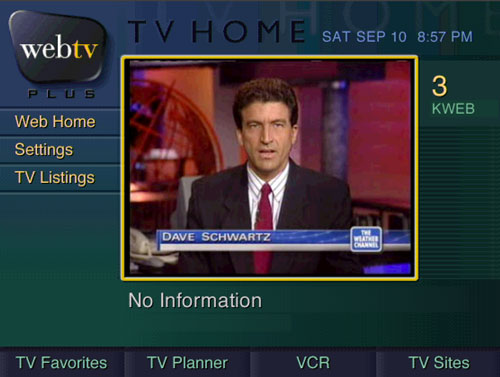
In 1997, Microsoft acquired WebTV Networks for approximately $425 million. WebTV was what we would now call a TV set-top box: that little box underneath your television that connects it to the internet. WebTV made it possible to view web pages and check email on your television.
That may sound perfectly normal today, but in 1997 it was quite difficult for several reasons. TV-screen resolution was far lower than that of a PC monitor, so you could not simply view any website. Sites had to be specially adapted. Microsoft completed the acquisition in August 1997, and the system was later rebranded as MSN TV.
In February 1998, Netcast—the company I worked for at the time, which later became part of Lost Boys – explored the (im)possibilities of using WebTV in the Netherlands. This small press item appeared at the time:
ING, KPN, PHILIPS, WEGENER ARCADE AND POSTBANK IN WEB TV TRIAL
Among others, ING, KPN, Philips, Wegener Arcade and Postbank appear to be preparing for a possible WebTV trial in the Netherlands in April.
The monthly magazine Adfo.com reports that Philips might introduce the WebTV Plus pilot project, designed to display web pages on TV screens using a remote control. It was expected to be easier to use than its predecessor, WebTV.
Such a device would cost no more than a few hundred guilders.
Netcast, a subsidiary of Wegener Arcade, was leading the project and confirmed that it was working on an implementation plan. Postbank, part of the ING Group, hoped to use WebTV to establish a fourth channel for handling financial transactions, alongside post, telephone and the PC. KPN was involved through the marketing department of its network company. It was possible that “Het PTT Net”, PTT Telecom’s semi-internet service, would play a role.
(Source: Planet Multimedia)
Just a small press item, with very little information to go on.
So, What Happened?
First, some background on why WebTV seemed exciting and potentially viable as a business opportunity.
In late 1997, one of our CEOs heard about the WebTV deal and became interested in the technology. Using a TV might have seemed like a strange idea, but at the time you could already use your television to look up the weather, sports results and TV listings through a system called “Teletekst”.
France had a similar system called Minitel, which used a modem and had existed since the early 1970s.
So, when WebTV promised a marriage between the internet and television, the idea piqued a lot of interest. Netcast was part of Wegener Arcade, a Dutch media conglomerate that owned many local newspapers, as well as TV10 Gold and The Music Factory—TMF, the very popular Dutch equivalent of MTV.
Netcast was the internet company Wegener Arcade had acquired. Wegener Arcade believed it had the content and that we had the technical skills to adapt that content—as well as our clients’ content—for use on a TV screen. It looked like a promising opportunity to bring the internet into the living room.
Or so the plan went.
If memory serves me well, our CEO brought a WebTV unit back after a family visit to Washington State. He bought one off the shelf in a store. You have to remember: Amazon had only just started selling music CDs alongside books—nothing else yet. It was not as if you could simply order one online.
In hindsight, bringing a WebTV device into the Netherlands was risky. At the time, there was officially still an export restriction because the device used what was regarded as “military-grade” encryption for data exchange. However: I am sure our CEO was totally oblivious to this fact, which makes him unknowingly “smuggling” a weapon out of the country actually funny.
Getting WebTV to work in the Netherlands was quite a hassle.
And that is where I came in.
I was officially tasked with trying to get the thing working so that we could show it to potential clients and Wegener Arcade executives.
Getting It to Work
The first hurdle was connecting the WebTV to a… TV.
Something I had not realised at first was that the device had obviously been designed for the US market, not Europe. Its output was 720 × 480 pixels at 60 Hz, using NTSC. European TVs at the time used 720 × 576 pixels at 50 Hz, using PAL.
My first attempt to start it up—after connecting it with a SCART cable—resulted in a black, distorted screen. Luckily, I figured out the problem. After all, I owned a modded PlayStation 1 and a collection of pirated NTSC games. What we needed was a TV that could handle both NTSC and PAL input.
Fortunately, we had some nice Sony Trinitron TVs in our lobby. After confiscating one for my little project, I finally had a working image.
From Alaska, with love
The next hurdle was even more complicated. Since WebTV did not work in the Netherlands at all, we first had to figure out how to activate it. According to the manual, you would simply dial in to a toll-free 1-800 number and follow the setup steps.
However: you can’t dial such numbers from abroad, let alone The Netherlands.
After some digging, I discovered that we should be able to dial-in – via a 33.6k modem – to a number in Anchorage, Alaska, to get online and activate the device.
Once I managed that the online registration process demanded a local address and telephone number to complete the setup, which I obviously did not have.
So the only option left was to contact WebTV customer support and talk my way in. Something that now would be called “social engineering”. Back then just a way to get things working.
Because of the ten-hour time difference, I had to stay at the office until around 9 p.m. to call technical support and see what they could do.
It was quite funny—and, I suppose, an early example of social engineering: trying to persuade someone to do something that normally would not be allowed. I told them that I was travelling and had brought the WebTV with me, but could not get it to work.
The person on the phone was friendly and patient, and tried several things. At one point, he even asked about my accent, which no doubt sounded rather strange to him. So I told him I was Dutch. Which made him say: “ Oh hey, I never talked to a Dutch person before.” We had even had a little small talk about time differences, the weather and such, after which he tried to help me out. After trying to coax the system a few times, he was unable to help and had to escalate the issue to another technician.
Since he could not call me back in the Netherlands, I had to call again the following day and ask for him. If I remember correctly, he then arranged an address and a code for the subscription linked to my boss’s American Express credit card.
Which was amazingly helpful.
After filling in more online forms in the WebTV and receiving email confirmations, I finally got online. We were in.
Usability
Once that happened, my initial enthusiasm faded real quick. My first thought was: “Wow this is janky. This will not work well.”
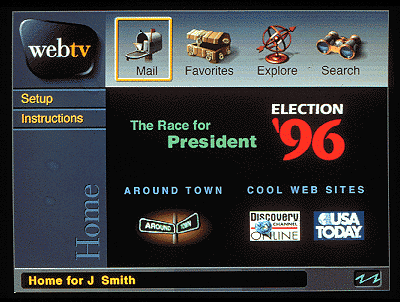
The interface was not terrible in terms of finding your way around, especially considering that you had to use a remote control. But it was far, far from great.
Most PCs had already moved from 640 × 480 resolution to a “whopping” 800 × 600, or even 1024 × 768 pixels.
And here was this tiny 720 × 480-pixel screen. You still had to read things – such as email – from several metres away. And, mind you, TVs in Europe were generally smaller than those in the US.
Usability expert Jakob Nielsen – the “guru” of that era – was impressed by the readability that WebTV’s developers achieved, saying that “you have to see it to believe it”. However, he still found the experience too limited for everyday use.
WebTV’s proprietary setup was part of the problem.
It was designed from the ground up to deliver a television-optimised 4:3 experience. Many Dutch websites simply fell apart when they loaded. It became painfully clear that making content work properly on such a device would require a great deal of effort.
Everything looked ugly, navigating with a remote control was not particularly enjoyable, and functions such as email were only really feasible with the optional keyboard.
And updating wasn’t like downloading and installing the last version of Netscape Navigator or the Microsoft browser. The embedded memory was a big restriction.
The Betrayal and the Downfall
A couple of months passed after I got WebTV working. At that point, I was not aware of anyone within our company actively working on a WebTV project. That was not surprising: there was no compatible hardware available, nor was there a business case that suited the subscription model.
As far as I know, we were waiting for a green light from the other business partners. I do know that we experimented with the Postbank website we had built, trying to make it work on a TV screen.
Meanwhile, one of the partners in this venture had been working on its own version of WebTV, using its own hardware. I assume this was because it felt that everything was taking too long.
In October 1998, KPN decided to launch its own WebTV service, called Net.box, using its own hardware made by a French company called Netgen. In my view, anyone with half a brain could see that it was doomed from the beginning.
For starters, the hardware was ridiculously expensive: up to four times the original US price of the device (799 guilders). If you wanted a wireless keyboard, it alone cost almost half the price of the device itself (299 guilders). You could also rent it for 29,95 guilders a month.
It also lacked any real optimized content, so it quickly failed – as did WebTV in the Netherlands overall. KPN lowering the price of the device to 99 guilders after about 8 months was definitely a last ditch effort to save the project.
It didn’t help.
On 5 November 1999, only a little over a year after its introduction, KPN pulled the plug on its system and hardware. Contemporary reporting described Net.Box as having definitively “flopped”.
It must have cost KPN at least a few million guilders. The now obsolete and useless hardware was sold off for next to nothing in several KPN-owned “PTT stores”. I remember seeing them priced off for 29,95 – but they still didn’t sell.
And that was the unceremonious end of WebTV in the Netherlands.
The End of WebTV in the US
Across the pond, WebTV – rebranded in 2001 to MSN TV – survived all the way until 2013. That year, Microsoft told users that it was shutting down the service because of dwindling user numbers and competition from modern devices. The final shutdown was on 30 September 2013. Microsoft had already stopped selling the hardware in 2009.
As PCs became cheaper, the internet became increasingly interactive, mobile phones emerged and even game consoles had gained web capabilities, the idea of WebTV became more and more obsolete.
And once the “smart-tv’ emerged, the convergence of tech was complete. Everything integrated nicely.
Although the opposite could be argued as well: devices like the AppleTV, GoogleTV and Roku’s are still very popular.
And what about WebTV?
Nowadays, there are community revival projects. Hobbyists and retro-tech fans intrigued by this obsolete technology, have created custom community servers, such as WebTV Redialed, to bring vintage hardware back online. With tools such as a Raspberry Pi and a dial-up emulator, enthusiasts can connect original WebTV boxes to custom web servers today.
It was probably inevitable that the concept would fail in the end. However, I still believe that KPN’s cowboy mentality at the time killed off what might have become a viable business opportunity for a few years.
But the real lesson was what our creative CEO had been saying from the start: “Content is King.”
People might have overlooked the janky hardware, but without the right content, Net.box was doomed from the start. And unlike Microsoft, KPN was not influential enough to make content creators interested in the platform.
Still, I greatly enjoyed this early form of pioneering with new technology, and having first-hand experience with it when it was still seen as something genuinely exciting.